
The 20-Foot Test: Stop Designing Your House From Six Inches Away
One of the most common things we see in interior design is people making decisions from six inches away.
They hold a tile sample in their hand and study every vein. They zoom in on a fabric and worry about one tiny variation in color. They stare at two paint swatches taped beside each other and debate a difference that is nearly imperceptible.
And yes, those details matter.
But no one lives in their house from six inches away.
Back Up
Walk to the doorway.
Stand across the room.
Look at the kitchen from the living room. Look down the hallway and notice what you see through multiple doorways at once.
That is how you actually experience your home.
As designers, we are constantly thinking about the bigger picture. What does the room read as a whole? Where does your eye go first? Does anything feel too heavy? Is there enough contrast? Do the materials relate to one another? Is there a clear focal point, or are ten different things fighting for your attention?
Those questions are often much more important than whether you prefer Sample A or Sample B when they’re sitting side by side on a table.
A Sample Isn’t a Room
A two-inch piece of marble doesn’t show you what an eight-foot island will feel like.
One cabinet door doesn’t show you what an entire wall of cabinetry will do to a room.
A wallpaper sample can’t fully communicate what happens when that pattern repeats across four walls.
And a paint swatch certainly doesn’t tell you exactly how that color will feel across hundreds of square feet, in changing natural light, under recessed lighting and beside everything else in the room.
Scale changes everything.
Something that feels bold in your hand may become surprisingly quiet once it’s installed.
Something that seems harmless on a small sample can become incredibly dominant when you repeat it 200 times.
This is why designing exclusively from samples can get people into trouble.
Stop Asking, “Do I Like This?” Try asking a different question: “What is this doing for the room?”
Those are two very different things.
You can love a tile and still decide it isn’t right for your bathroom.
You can love a chandelier and realize it’s competing with the architecture.
You can love a dramatic countertop and recognize that the room already has enough movement.
Good design isn’t a collection of things you love. It’s knowing which things get to speak and which things need to be quiet.
In fact, sometimes the best choice for a room is the one that seems a little boring when you’re looking at it by itself.
Its job isn’t to impress you while you’re holding the sample.
Its job is to make the entire room better.
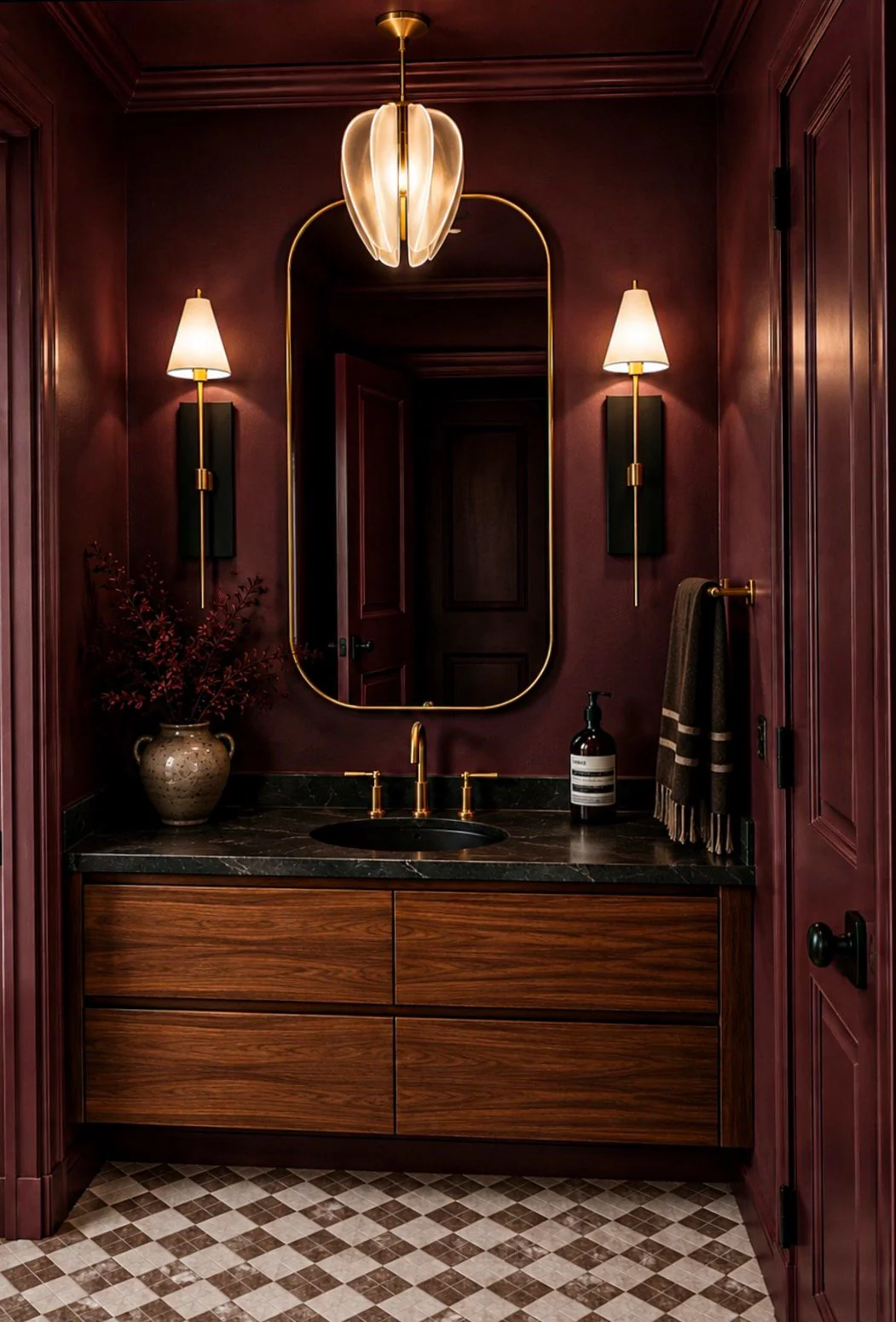
Who would have thought burgundy walls, a walnut vanity and soapstone countertop, PLUS brown and white tile would go together? Isolated, these materials sound horrendous, but together? It’s magic!
Why We Second-Guess Good Decisions
There is a particularly dangerous point in almost every renovation when the room is only partially installed.
The cabinets are in, but the countertops aren’t.
The wallpaper is up, but the lighting isn’t.
The tile is installed, but the grout isn’t.
The furniture has arrived, but the art and window treatments haven’t.
And suddenly, someone hates everything.
This is when the six-inch view can take over.
You’re evaluating unfinished details without all of the other elements that will eventually balance them.
A room is a composition. Judging it when half of that composition is missing rarely gives you an accurate picture of the finished space.
Try the 20-Foot Test: The next time you’re stuck on a design decision, physically back up.
Put the samples where they’re actually going whenever possible. Then stop staring at them.
Walk away.
Come back into the room normally.
Stand in the doorway. Look at it from across the room. Take a photo from farther away.
Then ask yourself: Does the room feel balanced? Does my eye know where to go? Is something demanding attention that shouldn’t be?
Does this choice support the overall direction of the room, or am I choosing it simply because I love it on its own?
Your home will ultimately be experienced from ten feet away, twenty feet away and sometimes from three rooms away.
Very rarely will anyone experience it with their nose six inches from the backsplash, so back up.
The answer is usually much clearer from there.
Love,
Lindsay