
There’s a moment in almost every project when someone asks:
“But does it match?”
And usually, I’m hoping the answer is no.
Not because a room shouldn’t feel cohesive. It absolutely should. But there’s a difference between a room that belongs together and a room where everything matches.
Matching is easy. Tension is what makes a room interesting.
So, What Is Tension in Interior Design?
Tension is that tiny bit of contradiction that makes your eye stop.
It’s an antique chest underneath a piece of modern art.
A very traditional room with a wildly oversized light fixture.
A delicate floral wallpaper against heavy, veined stone.
A beautifully tailored sofa beside an old table with scratches all over it.
It’s something that feels just unexpected enough.
And strangely, that one thing is often what makes everything else in the room work.
Beautiful Rooms Need an Argument
Not an actual argument. Although anyone who has renovated a house knows there will probably be a few of those, too.
I mean visually.
A room gets more interesting when two ideas are allowed to push against each other.
Old + new.
Masculine + feminine.
Polished + worn.
Quiet + dramatic.
Expensive + humble.
Traditional + modern.
If everything is soft, add something hard.
If everything is new, bring in something old.
If everything is serious, give the room something with a little humor.
If everything is beautiful, maybe add something a little strange.
That push and pull creates energy.
The Problem With Perfectly Coordinated Rooms
You know the rooms.
The chairs match the sofa. The lamps match each other. The wood tones are identical. Every metal finish is the same. The rug contains the exact colors found in the pillows, which coordinate perfectly with the artwork.
Nothing is technically wrong.
And yet somehow… nothing is happening.
Your eye takes it all in at once and moves on.
There’s nothing to discover.
That’s often why a room can contain very expensive furniture and still feel like a furniture showroom, and showrooms are designed to sell you things that coordinate.
Homes should tell stories.
This Is Why I Love Mixing Old Things With New Ones
One of the easiest ways to create tension is age.
A brand-new room needs something that looks like it existed before the renovation.
Maybe it’s an antique table.
An old oil painting.
A slightly beat-up wooden stool.
A vintage rug.
Something with patina.
When everything in a room arrived in boxes within the same six-month period, you can usually feel it.
Adding something old interrupts all that perfection.
Suddenly the room feels collected instead of purchased.
Tension Can Come From Scale, Too
Sometimes the unexpected thing isn’t a different style at all.
It’s simply bigger than you thought it should be.
A huge lantern over a breakfast table.
An enormous piece of art on a small wall.
A mirror that nearly fills the entire space above a vanity.
Curtains with far more fabric than technically necessary.
We’re often so afraid of making something too big that we make everything slightly too small.
And small, safe choices rarely create memorable rooms.
Even a Bathroom Needs Tension
Actually, bathrooms might be one of my favorite places to use it.
Take a room with elaborate wallpaper and pair it with substantial stone.
Add a traditional painted vanity, but choose a mirror with an unusual silhouette.
Use aged brass against a deep, muddy paint color.
Let something feel ornate and something else feel restrained.
The goal isn’t for someone to walk in and immediately identify every individual element.
The goal is for the whole room to feel like it has depth.
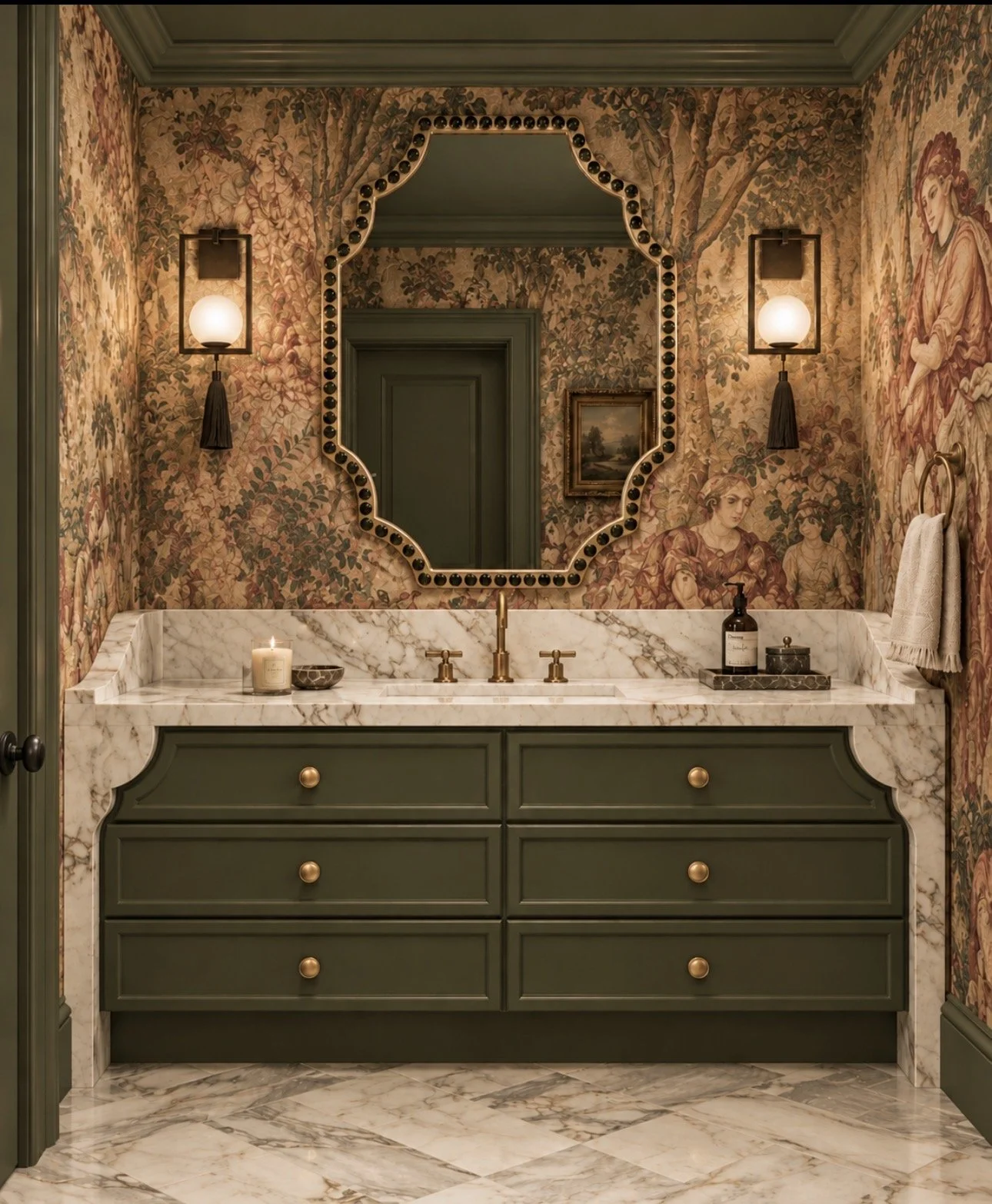
We chose modern sconces over vintage wallpaper, and chunky stone against a traditional vanity topped with a modern mirror for this space. All of this creates tension in the best way.
But Tension Isn’t the Same as Chaos
This is the important part.
You don’t need ten unexpected things.
You probably need one or two.
There still has to be a thread running through the room—color, proportion, material, architecture or mood.
Good tension feels intentional.
Bad tension feels like you bought everything you liked and hoped it would work together. And there is a difference.
Stop Trying to Make Everything Get Along
Some of my favorite rooms have something in them that, on paper, probably shouldn’t work.
And I think that’s exactly why they do.
The antique doesn’t need another antique beside it.
The brass faucet doesn’t require every piece of hardware in the house to be brass.
The modern art doesn’t require modern furniture underneath it.
And the wallpaper doesn’t need a pillow somewhere that “pulls out the color.”
Sometimes we need to stop helping everything match.
Let one thing interrupt the room.
Let something be too big.
Let something be old.
Let something be a little strange.
Because a beautiful room can make you look.
But tension is what makes you look again.
Love,
Lindsay