
The Art Of A Collected Home
There is something about a room that feels as though it came together slowly.
Not because every piece matches. Not because everything was purchased at the same time. And certainly not because it follows one particular design style.
It works because every piece feels like it belongs there.
That was the idea behind this dining room. I wanted it to feel warm, layered, a little unexpected, and collected over time—the kind of room where you could host a beautiful dinner, but also sit around the table long after everyone has finished eating.
And more than anything, I wanted it to feel personal.
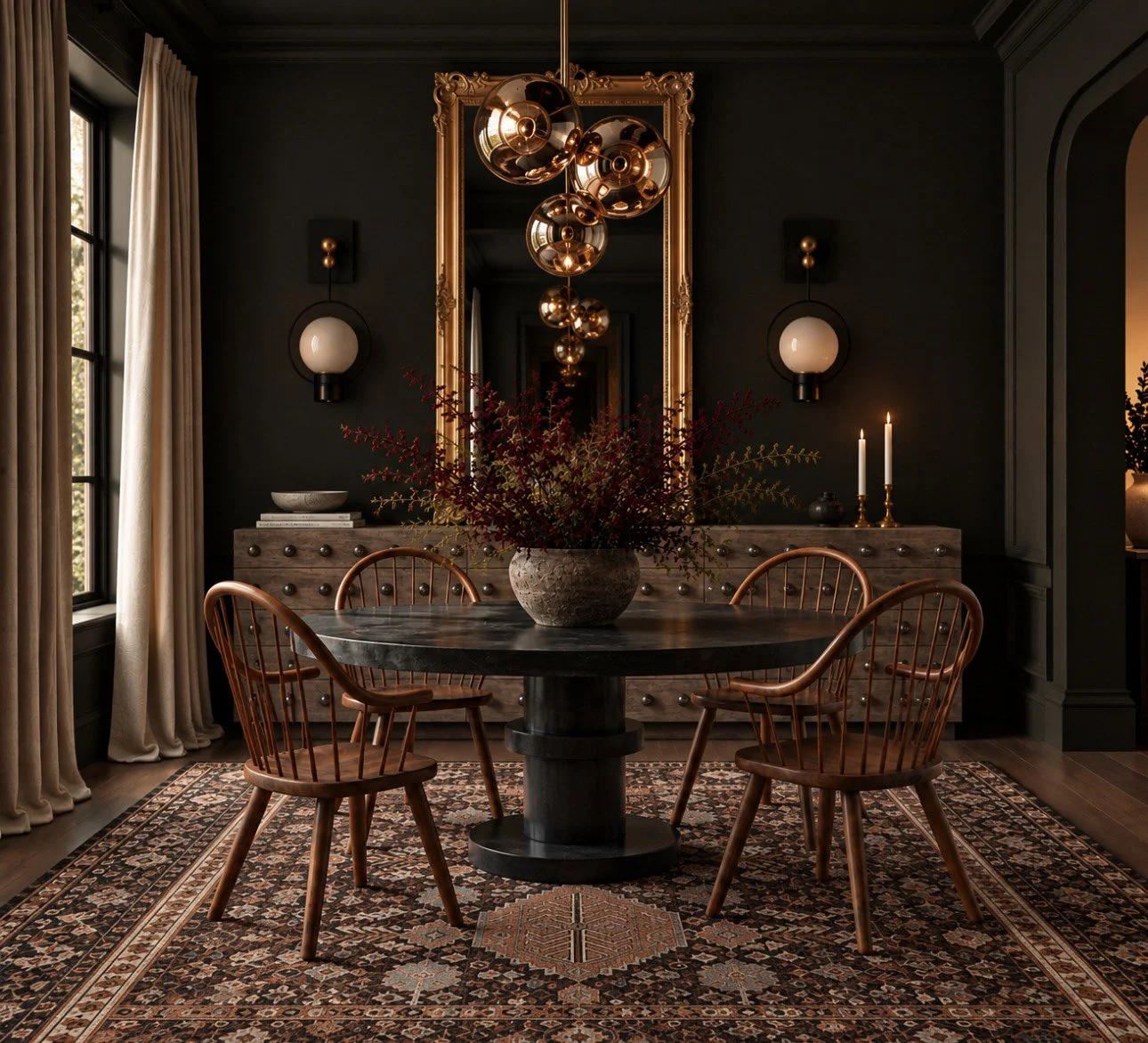
A dining room designed to feel collected over time—where sculptural lighting, warm wood, vintage-inspired pieces, and layers of texture come together against the drama of Tricorn Black.
The Best Rooms Aren’t Perfectly Matched
One of the questions I hear often is, “How do I mix old and new without making my house feel disjointed?”
I think the answer is to stop trying so hard to make everything match.
Some of my favorite interiors combine pieces that, on paper, shouldn’t necessarily go together.
In this room, a traditional gilded mirror lives behind a much more modern dining table. Warm wood Windsor-style chairs sit beneath a sculptural contemporary light fixture. A beautiful patterned rug brings age and softness beneath cleaner, heavier furniture.
None of those pieces belong to one specific style.
But together, they create a room with personality.
When everything in a space comes from the same collection, the same time period, or the same design aesthetic, the room can feel finished—but not necessarily interesting.
It’s the contrast that gives a room depth.
Start With Something You Love
When I’m designing a room with a collected feel, I don’t necessarily begin by deciding what “style” the room will be.
I would rather start with one piece that makes you feel something.
Maybe it’s an antique mirror you found while traveling. Maybe it’s a rug you’ve had for years. Maybe it’s an incredibly modern light fixture that you cannot stop thinking about.
Start there.
Then, instead of asking, “What matches this?” ask, “What would make this more interesting?”
That one shift can completely change the way you design a home.
An ornate antique becomes more interesting next to something simple. A modern table feels warmer surrounded by chairs with history. A dark room feels softer when you introduce natural wood, linen, and an old rug.
You aren’t trying to match pieces.
You’re creating a conversation between them.
Embracing the Dark
The walls, trim, and ceiling in this room are all Sherwin-Williams Tricorn Black, and that decision is a huge part of what gives the space its mood.
There can be a tendency to assume that a dark room needs to be “lightened up.” Sometimes it doesn’t.
Sometimes the best thing you can do is lean into what the room naturally wants to be.
Taking the dark color across the walls, molding, and ceiling removes all of those visual stopping points. Instead of noticing where the wall ends and the trim begins, your eye moves around the room as a whole.
The black also creates an incredible backdrop for everything layered in front of it.
The aged gold mirror feels richer. The wood chairs feel warmer. The subtle colors in the rug become more noticeable. Even the simple neutral drapery suddenly has presence.
Dark paint doesn’t have to make a room feel cold. Surrounded by the right materials, it can actually make a room feel incredibly intimate.
Warmth Comes From Texture, Not Just Color
When people think about making a room feel warm, they often immediately think about paint color. But warmth comes from so much more than color.
Here, it comes from the grain of the wood chairs. The worn character of the rug. The aged finish on the credenza. The heavy folds of the linen drapery. The imperfect gold finish of the mirror. The organic branches on the table.
Those materials keep the black from ever feeling flat.
This is especially important when you’re working with a very dark palette.
If everything were sleek, polished, and new, this room would feel completely different. Instead, the variation in texture gives it softness and soul.
Let One Thing Be Unexpected
Every room needs something that keeps it from becoming too predictable.
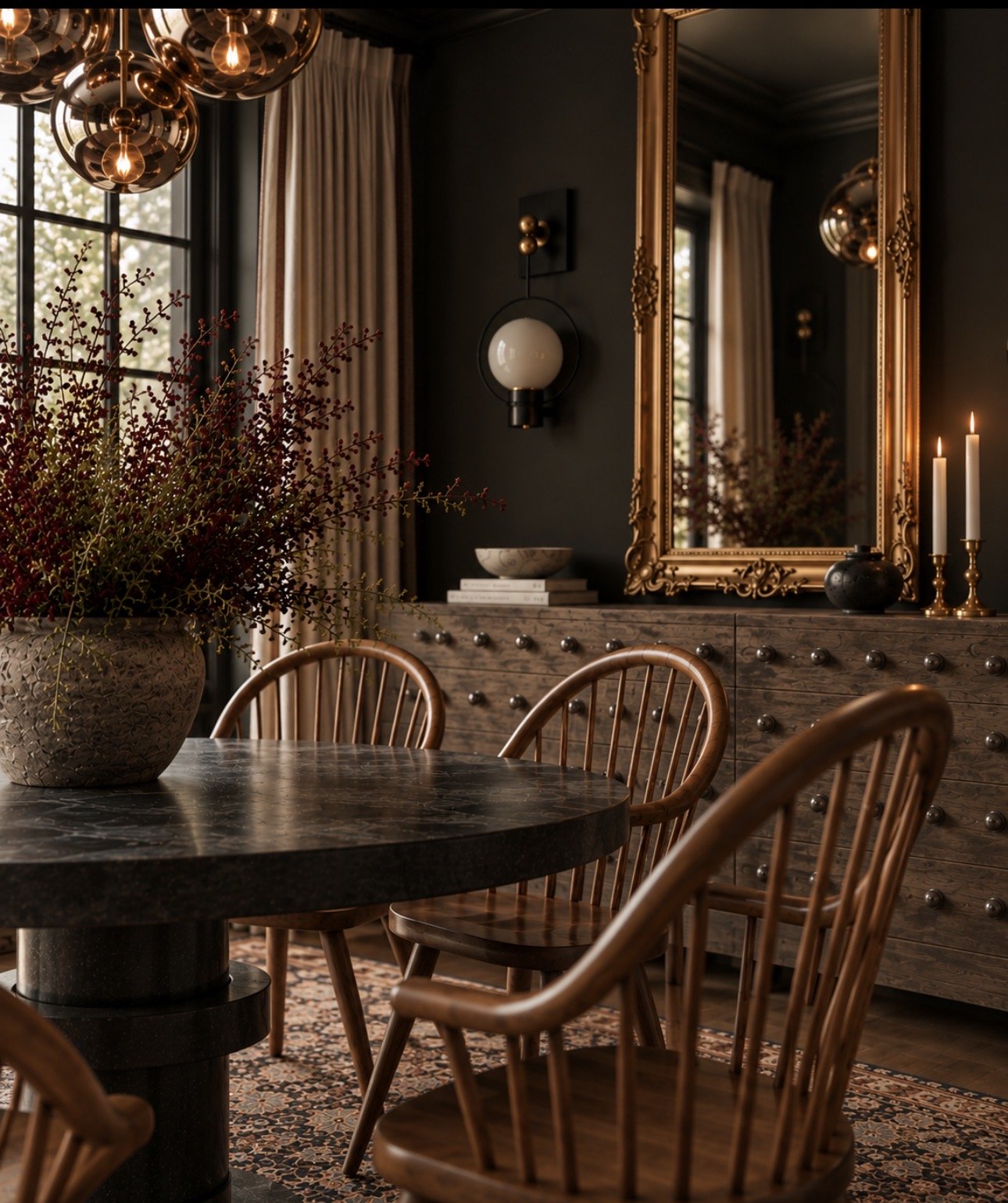
In this space, it’s the chandelier.
We could have chosen a beautiful traditional fixture, and it would have worked perfectly well with the antique mirror and Windsor-style chairs. But “perfectly well” isn’t always the goal.
The sculptural glass fixture introduces a completely different design language. It feels modern and artistic against the more traditional elements in the room.
And because the rest of the space has so much history and texture, that juxtaposition feels intentional rather than out of place.
I love that moment in a room—the thing you might not have chosen at first, but ultimately becomes the thing that makes the entire space.
Give a Room Somewhere Quiet to Breathe
Originally, I considered bringing another color into the drapery. But the more the room developed, the more I realized it didn’t need it.
There was already color in the rug. Burgundy and olive in the arrangement. Warm brown in the chairs. Gold in the mirror and lighting.
Adding another detail to the curtains would have been just that—another detail.
Instead, the thick neutral drapery became a place for the eye to rest.
And I think that’s something we sometimes forget when designing. Not every element needs to be the interesting element.
Some pieces are there to support everything around them.
Those quieter moments are often what allow the statement pieces to really shine.
Your Home Doesn’t Need to Be Finished Tomorrow
Maybe this is the part I love most.
The most interesting homes rarely look as though someone ordered everything at once.
They evolve.
You find an antique you weren’t looking for. You move a chair from another room and suddenly realize it belongs there. You replace something you bought years ago with something that feels more like you now.
There is beauty in allowing that process to happen.
Your home is allowed to change as you change.
And you don’t need to fill an empty corner simply because it’s empty.
Wait for the right thing.
Buy fewer pieces that mean more.
Mix the expensive piece with the vintage find. Put something contemporary next to something that’s been around for a hundred years. Keep the piece that technically doesn’t “match” if you absolutely love it.
Because ultimately, the goal isn’t to create a house where someone walks in and recognizes a particular design style.
The goal is to create a home where someone walks in and recognizes you.
A Home Collected Over Time
I think we are surrounded by more design inspiration than ever before.
We save beautiful rooms every day. We see trends come and go. We’re constantly being shown what is new and what we should buy next.
But the rooms that stay with me are rarely the ones that follow every rule.
They are the ones with history.
They have something slightly imperfect. Something inherited. Something new. Something unexpected.
They make you curious about the people who live there.
That is what I want a home to feel like.
Not decorated for a photograph.
Not designed around a trend.
But layered with pieces you love, experiences you’ve had, and things you’ve collected along the way.
Because a beautiful home isn’t about finding everything that matches.
It’s about slowly discovering what belongs together.
And I think that’s where the magic really begins.
Love,
Lindsay